

We've arrived! We actually arrived a month ago, and moved into a 2-bedroom house in Port Jefferson, NY (thanks so much, Emily, for the encouragement - it's actually working for us, for now. We're using some of the boxes of books to divide the kids' bedroom into a half for the boys and a half for P). Ari is loving his job at Stony Brook University, and I'm trying to make up for November being a complete loss in terms of schooling. In addition to teaching the children, I'm working on navigating New York's home school reporting requirements (which are much more stringent than those in Texas... they exist, to begin with... more on that later). I'm enjoying having my own kitchen, and have been doing a lot of cooking and baking. We found a farmer's market where you can get local apples for around 40 cents a pound. Pie, anyone?
We returned to Texas for Christmas (a 2-day drive, but worth it to see family and friends again), and only just got back. It's nice not to be in the car any more, though all 3 kids did really well. Apart from the part where B found the box of his disposable diapers, and threw about 35 of them all over the car, and the older 2 then used the empty box as a projectile... aaaaah! And B developed a habit of yelling, over and over, "Please stop reading Hobbit, Mommy! Please stop reading Hobbit, Mommy!" But usually, he gave up after a few paragraphs to pages, and we successfully followed the adventurers all the way over the Misty Mountains, across Mirkwood, and to Smaug's demise. We have yet to see the results of the dwarves' gold lust, but we'll save that for after B's bedtime but before P and E's over the next few weeks.
I promised to blog about the Vibrant Dance conference Ari and I attended at the end of October (see my previous post). Being closely related to one of the organizers, we had the opportunity to attend the dinner for the speakers the night before the conference began. As the dinner was winding down, we joined a conversation with Bruce Waltke. I thought I'd start with something he said both at the dinner and in one of his talks, because it has important implications for Christian unity. He described his response to the question, "Who is my brother [or sister]?" To answer the question, he looked at how Abraham, Moses, or David might have seen it. God gave Abraham the covenant of circumcision - an external, physical sign of inclusion in the people of God. For Christians, that sign has been replaced by baptism. So if you have been baptized, you might be my brother or sister. The covenant God made with Moses involved the Law, of which the Ten Commandments are the most important part. So if you acknowledge your responsibility before God to follow the Ten Commandments, you might be my brother or sister. (Aside: no-one except Jesus has actually followed all ten commandments perfectly - I believe Bruce Waltke's point was simply that Christians acknowledge them as a standard to aim for; that we recognize the fact of God's righteousness as represented in the Ten Commandments). The covenant God made with David was that the kingdom would be his family's forever - a physical descendant of his would reign as king. So if you acknowledge Jesus, David's heir, as the king of your life, you might be my brother or sister. Finally, in the New Testament, we see Jesus' incarnation, death, and resurrection. So if you accept those historical realities, you might be my brother or sister.
To sum up, if I find myself asking whether someone is my brother or sister in Christ, I can ask: Are they willing to be publicly identified with him? Do they acknowledge God's perfect law and righteousness? Have they submitted to Jesus' kingship? Do they believe that Jesus was fully God as well as fully man, that he died, and that he returned to life?
Note, of course, that nowhere in this analysis does someone's position on the timespan of God's creation appear - we can be brothers and sisters in Christ no matter how we interpret those particular details. I think that having that perspective is an essential prerequisite for having a gracious dialogue: we start from the understanding that we are brothers and sisters in Christ, and dialogue on the details on which we differ knowing that we're all going to be around the same Thanksgiving table as part of God's family a million years from now.
I should say, I didn't take detailed notes of what Bruce Waltke had to say - the above summary is based on my memory, 2 months later, of what I heard him say. So I may have made some errors in representing him. If you're unhappy with any of the above, the fault is more likely to be mine than his.
Friday, December 30, 2011

Thursday, November 3, 2011
Moving!
Ari got a job! He'll be working as a postdoctoral researcher at Stony Brook University, looking at data from the Spitzer Space Telescope to study brown dwarfs (the mysterious objects that are too big to be planets, but too small to be stars). The start date is Dec. 1, so we will be spending the next few weeks immersed in the educational experience of putting everything into a moving truck and driving it across the country. Next week, my inlaws will watch the kids while Ari and I fly out to look for housing. We're hoping for a 3-bedroom place that doesn't cost much more than a third of Ari's income and won't require hours of commuting for him. On Long Island, that's easier said than done, but I know God has a good place for us. We look forward to seeing how it works out.
Last weekend, Ari and I attended a conference (Creation: Biblical Options) organized by my father-in-law. My mother-in-law watched the kids, so I was able to hear almost every talk. I also helped Ari sell a few books at his booth during free time, since Ari was filling the role of conference photographer. I don't often get to go to conferences like this (or like anything), and it was such a blessing to be challenged to think in completely different ways than I usually do. Being close to the conference organizer, I got to interact with several of the speakers more than most of the conference attendees - Ari and I were invited to the speakers' dinner, and we stayed in the same hotel as the speakers. I'm planning on composing a few posts on what different individuals had to say. But, given that we're in the middle of moving across the country, future posts may take a while to appear. For now, I'll just say that although I don't agree with all the speakers' perspectives, I was encouraged and challenged by every one of them, and impressed at the graciousness with which they related to one another despite their disagreements.
Last weekend, Ari and I attended a conference (Creation: Biblical Options) organized by my father-in-law. My mother-in-law watched the kids, so I was able to hear almost every talk. I also helped Ari sell a few books at his booth during free time, since Ari was filling the role of conference photographer. I don't often get to go to conferences like this (or like anything), and it was such a blessing to be challenged to think in completely different ways than I usually do. Being close to the conference organizer, I got to interact with several of the speakers more than most of the conference attendees - Ari and I were invited to the speakers' dinner, and we stayed in the same hotel as the speakers. I'm planning on composing a few posts on what different individuals had to say. But, given that we're in the middle of moving across the country, future posts may take a while to appear. For now, I'll just say that although I don't agree with all the speakers' perspectives, I was encouraged and challenged by every one of them, and impressed at the graciousness with which they related to one another despite their disagreements.
Tuesday, October 11, 2011
Advantages of Older Siblings
Not having any older siblings myself, I can only speak from what I've observed in my own kids. However, I'm amazed at things that B is able to do at 20 months of age that E wasn't yet able to do, and P certainly wasn't anywhere near able to do.
I vividly remember P's verbal skills at 20 months, because that was when E was born. She could say single words, but they were typically hard to recognize ("bee" meant spoon, "na" meant towel, and several other items were "ba"). She never included more than one consonant in any word, using only vowel sounds to distinguish between "baby", "banana", "ball", and "book". I told Ari that we'd better not space subsequent kids that close together - having 2 little people who couldn't verbally communicate was just too difficult.
When E was 20 months old, he was starting to use 2-word sentences, and his pronunciation was leaps and bounds ahead of where P's had been at the same age. Of course, when P finally did learn to talk, she talked nonstop, and E was a convenient audience. He had at least double the live, personalized verbal interaction directed at him as P had had directed at her when she was that small.
Now that B is 20 months old, he has the benefit of 2 older siblings. They are both so much older than him that their pronunciation is practically perfect, as is their grammar. All morning long, they interact with letters and numbers, which B is able to observe but not really participate in. Like any small child, he is eager to catch up. So, at least a month ago, he started noticing words. He points at them and says, "E, O." When I read Goodnight Moon to him at bedtime, he takes my finger, points it to the words, and commands, "E! O!" Usually I satisfy this demand by telling him, slowly, what each word says. Sometimes he points to individual letters and I tell him what sound they make.
B has also become interested in numbers. Now, I remember that E was able to count to 10 by his second Christmas, when he was around 21 months old. Little B, however, has upped the ante by being able to recognize numerals from 1 to 8. He can recognize 9, but usually identifies it as a 6. (Of course, if you look at it upside down, they are the same thing - I'm not going to worry about my one-year-old's problems with reversals!) He'll take any counting book, open it entirely at random, and accurately identify the numeral while pointing at it: "Four! Seven! Eight!" While we were in the car waiting at a red light yesterday, I heard him announce, "One! Eight! Six!" I looked at the car beside us, and its license plate contained some letters and the numbers 98881. So, he thought the 9 was a 6, but other than that was exactly right. This afternoon, he started pointing out numbers on the box of disposable diapers in his room - a picture of a diaper is labeled from 1 to 6 describing all its fantastic features. The numbers are in no order at all, but he identified all of them correctly. The box informed us that it contained 140 diapers, and B pointed to those numerals and said, "One! Four! Round round round!" I told him that the round number was zero, and a minute later he correctly identified it.
I know, of course, that being able to say the name of a numeral has nothing to do with understanding that numbers have value. I'm working on helping him make the connection by holding up the right number of fingers each time he exclaims about a number, and I know it will come in time. But for now, I can at least brag that my 1-year-old is pre-reading: he understands that symbols stand for sounds or ideas. I'm pretty sure P and E are largely responsible for this early understanding. I'm already finding it easier to teach E to read than P - are the kids going to work me out of a job?
I vividly remember P's verbal skills at 20 months, because that was when E was born. She could say single words, but they were typically hard to recognize ("bee" meant spoon, "na" meant towel, and several other items were "ba"). She never included more than one consonant in any word, using only vowel sounds to distinguish between "baby", "banana", "ball", and "book". I told Ari that we'd better not space subsequent kids that close together - having 2 little people who couldn't verbally communicate was just too difficult.
When E was 20 months old, he was starting to use 2-word sentences, and his pronunciation was leaps and bounds ahead of where P's had been at the same age. Of course, when P finally did learn to talk, she talked nonstop, and E was a convenient audience. He had at least double the live, personalized verbal interaction directed at him as P had had directed at her when she was that small.
Now that B is 20 months old, he has the benefit of 2 older siblings. They are both so much older than him that their pronunciation is practically perfect, as is their grammar. All morning long, they interact with letters and numbers, which B is able to observe but not really participate in. Like any small child, he is eager to catch up. So, at least a month ago, he started noticing words. He points at them and says, "E, O." When I read Goodnight Moon to him at bedtime, he takes my finger, points it to the words, and commands, "E! O!" Usually I satisfy this demand by telling him, slowly, what each word says. Sometimes he points to individual letters and I tell him what sound they make.
B has also become interested in numbers. Now, I remember that E was able to count to 10 by his second Christmas, when he was around 21 months old. Little B, however, has upped the ante by being able to recognize numerals from 1 to 8. He can recognize 9, but usually identifies it as a 6. (Of course, if you look at it upside down, they are the same thing - I'm not going to worry about my one-year-old's problems with reversals!) He'll take any counting book, open it entirely at random, and accurately identify the numeral while pointing at it: "Four! Seven! Eight!" While we were in the car waiting at a red light yesterday, I heard him announce, "One! Eight! Six!" I looked at the car beside us, and its license plate contained some letters and the numbers 98881. So, he thought the 9 was a 6, but other than that was exactly right. This afternoon, he started pointing out numbers on the box of disposable diapers in his room - a picture of a diaper is labeled from 1 to 6 describing all its fantastic features. The numbers are in no order at all, but he identified all of them correctly. The box informed us that it contained 140 diapers, and B pointed to those numerals and said, "One! Four! Round round round!" I told him that the round number was zero, and a minute later he correctly identified it.
I know, of course, that being able to say the name of a numeral has nothing to do with understanding that numbers have value. I'm working on helping him make the connection by holding up the right number of fingers each time he exclaims about a number, and I know it will come in time. But for now, I can at least brag that my 1-year-old is pre-reading: he understands that symbols stand for sounds or ideas. I'm pretty sure P and E are largely responsible for this early understanding. I'm already finding it easier to teach E to read than P - are the kids going to work me out of a job?
Wednesday, September 28, 2011
Fun with Moebius Noodles

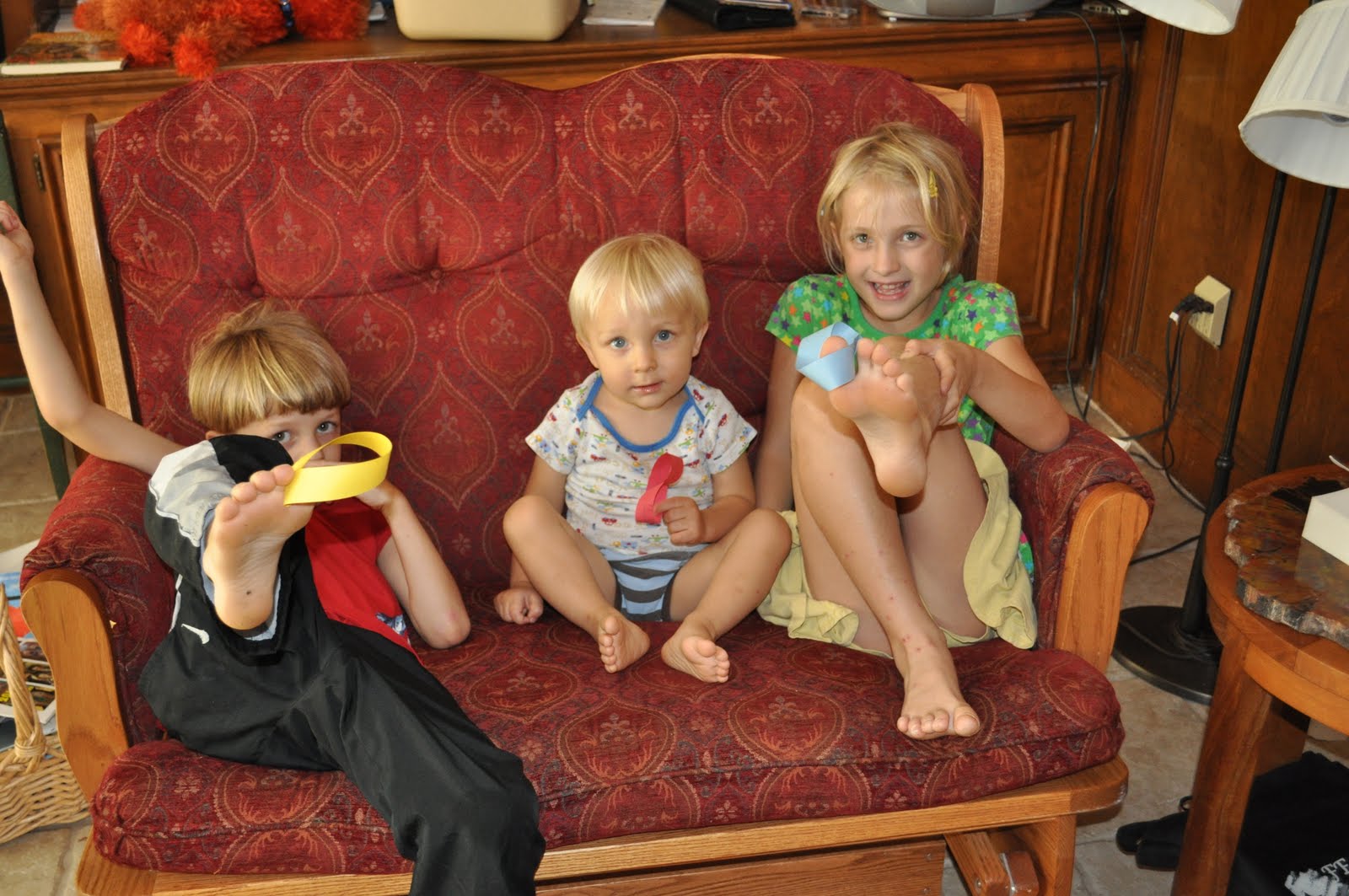
About 2 weeks ago, I stumbled across the Moebius Noodles group referenced on the Let's Play Math blog. Inspired by the idea of sharing cool math with my kids, we spent last Wednesday playing with Moebius noodles. For those of you who don't know, a Moebius noodle (also known as a Moebius band or strip) is a loop of a flat material (usually paper) that is twisted once before the ends are joined. Here, B demonstrates one.

Both P and E's fine motor skills are at a level where they can make their own, so they pasted together both regular loops and Moebius noodles. I had them each draw a line down the middle of "only one side" of each loop. One fascinating thing about Moebius noodles is that they only have one side. We then experimented with cutting our loops in half lengthwise. With a regular loop, of course, you get 2 loops. With a Moebius noodle, well... try it yourself if you've never done it. It's really fun, and surprising the first time.
Since we were still enjoying ourselves and it wasn't lunch time, I thought I'd try out another idea I stumbled upon. The gist is that you take two loops, glue them together, and then cut them both in half lengthwise. First, I took two regular loops and glued them at right angles. It looked like the beginnings of a chain you might put on a Christmas tree, only the connection was on the outside. I cut it in half down the middle of each loop, through the intersection point, and ended up with this:

P thought this was interesting, and tried it herself (by this time, E was busy attaching yellow loops to a piece of paper to make a "rocket", which seemed valuable in its own way). Meanwhile, I tried what happened when one of the loops is a Moebius noodle and one is a regular loop, which turns out to be the same as when both are regular loops. Finally, I tried both of the possible ways of joining two Moebius noodles: one when the loops are twisted the same direction, and one when they're twisted in opposite directions. I found it completely mind-bending! When the loops are twisted in the same direction, you get this:

But when they're twisted in opposite directions, this is what you get. (P tried this one as well, though I had to help her make the Moebius noodles so that they'd be even enough to cut in half neatly).

An instant "I LOVE MATH" logo!
Monday, September 12, 2011
Breakfast Math
Sometimes, marketing opens the door to a great educational experience.
Our box of Raisin Bran proclaimed, in large letters, "$100 CASH CARD INSIDE". In smaller letters, one realizes that in truth, "you could find up to a..." If you read the fine print, you find that your odds of finding that $100 cash card are 1 in 24,800. There are other prizes, though: a $50 cash card (1 in 20,667), a $25 cash card (1 in 17,714), a $10 cash card (1 in 15,500), and a $5 cash card (1 in 12,400). So I read these statistics to the kids and solicited guesses on just how many boxes of Raisin Bran one would have to buy to be likely to get any cash card at all. Then I hauled out my calculator and did the math: the total odds, obtained by adding the odds of each value of cash card, are 1 in 3444. If you bought 3444 boxes, though, you still wouldn't be guaranteed to get a cash card (though you'd have better than even odds). We discussed how long it might take to eat 3444 boxes of cereal (about a decade, if the whole family only ate Raisin Bran for breakfast every single day - we could probably polish off a box a day between us). And if you bought 3444 boxes of cereal, you'd most likely only get one cash card, which would most likely be a $5 cash card.
P and E - mostly E - have invented a useful number, the gi (hard g, rhymes with pea). One gi is generally defined as "a number larger than the one you were just talking about by a considerable margin". So we find it helpful to suggest, "even if you tried gi times, you wouldn't be able to throw an apple all the way up to the moon," or "do I have to ask you gi times to clean your room?" E announced, "If you bought a gi of cereal boxes, you'd probably only find 1000 cash cards. That's how big a gi is."
Okay, I'm curious. How large does gi have to be in order for 1000 to be the most likely number of cash cards when the odds of finding one is 1 in 3444? I think all the probability and statistics I was taught at Caltech has fallen out of my head. Anyone care to remind me?
Our box of Raisin Bran proclaimed, in large letters, "$100 CASH CARD INSIDE". In smaller letters, one realizes that in truth, "you could find up to a..." If you read the fine print, you find that your odds of finding that $100 cash card are 1 in 24,800. There are other prizes, though: a $50 cash card (1 in 20,667), a $25 cash card (1 in 17,714), a $10 cash card (1 in 15,500), and a $5 cash card (1 in 12,400). So I read these statistics to the kids and solicited guesses on just how many boxes of Raisin Bran one would have to buy to be likely to get any cash card at all. Then I hauled out my calculator and did the math: the total odds, obtained by adding the odds of each value of cash card, are 1 in 3444. If you bought 3444 boxes, though, you still wouldn't be guaranteed to get a cash card (though you'd have better than even odds). We discussed how long it might take to eat 3444 boxes of cereal (about a decade, if the whole family only ate Raisin Bran for breakfast every single day - we could probably polish off a box a day between us). And if you bought 3444 boxes of cereal, you'd most likely only get one cash card, which would most likely be a $5 cash card.
P and E - mostly E - have invented a useful number, the gi (hard g, rhymes with pea). One gi is generally defined as "a number larger than the one you were just talking about by a considerable margin". So we find it helpful to suggest, "even if you tried gi times, you wouldn't be able to throw an apple all the way up to the moon," or "do I have to ask you gi times to clean your room?" E announced, "If you bought a gi of cereal boxes, you'd probably only find 1000 cash cards. That's how big a gi is."
Okay, I'm curious. How large does gi have to be in order for 1000 to be the most likely number of cash cards when the odds of finding one is 1 in 3444? I think all the probability and statistics I was taught at Caltech has fallen out of my head. Anyone care to remind me?
Saturday, September 3, 2011
Whine
I want to post replies to comments that people have left. But every time I try, I get the following message, repeatedly:
"Your current account (my@email.address) does not have access to view this page."
What? I can't comment on my own blog? Does anyone who knows more about arguing with Blogger know how to fix this?
"Your current account (my@email.address) does not have access to view this page."
What? I can't comment on my own blog? Does anyone who knows more about arguing with Blogger know how to fix this?
Reading Strategies
I had 2 good teaching ideas for E's reading lessons this week. One of them actually worked.
I mentioned that he was finding it hard to distinguish "b" and "d". So on Monday morning, having gleaned this idea from the Sonlight forums, I wrote the word "bed" in large lowercase letters. Then, I drew a stick figure lying horizontally on top of the word: "bed" looks a bit like a bed, with bedposts on either end. However, if you write "deb", there's no space for your stick figure to stretch out to sleep. So to figure out the difference, you find out if your letter would leave space for your stick figure to sleep if it was at the "B"eginning or at the en"D" of "bed". This seemed to work pretty well, and E started reading the first of his readers that contained both "b" and "d". After a few successful efforts at sounding out words, he looked up at me and said, "Do you know how I tell the difference?" I anticipated hearing something about how well my careful, clever explanation was working for him, but what he said was, "The 'b' doesn't have a tag at the bottom, and the 'd' does." In the font used in his readers, this is true. So it works reliably for him - he's had ZERO struggles since Monday morning when it comes to sounding out "b" and "d". I'm amused that he came up with something that didn't even occur to me, and it works great for him. Hopefully by the time he moves on to reading material that doesn't have that feature, he'll have internalized the other differences between the two letters.
The other great idea I had, which actually is working, was for helping E recognize and remember the word "the". Sounding it out each time was driving him nuts, and he really hated that he just had to remember that it didn't work that way. I'd just been telling him what the word was for over a week, when I had an idea. A while back, I heard a blonde joke (most of which I think are really stupid). A blonde is sitting on a bench with a book, and looking concerned, and saying, "ta-hee! ta-hee!" A brunette comes along, takes a look, and tells her, "'The', airhead!" Well, I didn't need to encumber E with the setup of the joke (both his siblings being blonde), but I told him, "When you sound out 'the', it sounds a bit like laughing: 'ta-hee!'." So now, whenever he encounters the word in his reader, he says "ta-hee...(giggle)...the!" What had been a roadblock for him is now something he finds amusing.
I mentioned that he was finding it hard to distinguish "b" and "d". So on Monday morning, having gleaned this idea from the Sonlight forums, I wrote the word "bed" in large lowercase letters. Then, I drew a stick figure lying horizontally on top of the word: "bed" looks a bit like a bed, with bedposts on either end. However, if you write "deb", there's no space for your stick figure to stretch out to sleep. So to figure out the difference, you find out if your letter would leave space for your stick figure to sleep if it was at the "B"eginning or at the en"D" of "bed". This seemed to work pretty well, and E started reading the first of his readers that contained both "b" and "d". After a few successful efforts at sounding out words, he looked up at me and said, "Do you know how I tell the difference?" I anticipated hearing something about how well my careful, clever explanation was working for him, but what he said was, "The 'b' doesn't have a tag at the bottom, and the 'd' does." In the font used in his readers, this is true. So it works reliably for him - he's had ZERO struggles since Monday morning when it comes to sounding out "b" and "d". I'm amused that he came up with something that didn't even occur to me, and it works great for him. Hopefully by the time he moves on to reading material that doesn't have that feature, he'll have internalized the other differences between the two letters.
The other great idea I had, which actually is working, was for helping E recognize and remember the word "the". Sounding it out each time was driving him nuts, and he really hated that he just had to remember that it didn't work that way. I'd just been telling him what the word was for over a week, when I had an idea. A while back, I heard a blonde joke (most of which I think are really stupid). A blonde is sitting on a bench with a book, and looking concerned, and saying, "ta-hee! ta-hee!" A brunette comes along, takes a look, and tells her, "'The', airhead!" Well, I didn't need to encumber E with the setup of the joke (both his siblings being blonde), but I told him, "When you sound out 'the', it sounds a bit like laughing: 'ta-hee!'." So now, whenever he encounters the word in his reader, he says "ta-hee...(giggle)...the!" What had been a roadblock for him is now something he finds amusing.
Subscribe to:
Posts (Atom)