
Thursday, September 23, 2010
Ancient mysteries solved!
Last Friday, I decided to introduce P to addition with regrouping (what you do if the sum of the ones digits is greater than 10, as in 27+64). I carefully laid out the problem, and explained each step thoroughly. As soon as I carried the 1, P cried out, "Oh! I've been wondering about that 1 for years!" Upon being questioned, she informed me that a big kid in our old church in PA (where we lived over a year ago) had demonstrated addition with regrouping, and P had not understood it then. Interestingly, I had tried to explain the same concept about 6 months ago, but P didn't catch on and I left it for later. Half a year's growth and a deeper understanding of place value has made a huge difference. Apparently, Math on the Level's maturation-based approach works!

Willpower!
We spent last weekend in St. Louis for Ari's uncle's wedding. Our plans were quite flexible, and since I didn't know how much time we'd be spending there, I packed most of our school books into the heavy-duty Sonlight tote and brought them along with us. All day Friday, my mother-in-law was preparing to host the rehearsal dinner, and school was a reasonable way to keep the kids occupied. We headed down to the finished basement and put their pencil cases on the ping-pong table. There were fewer toys around to distract everyone (though baby B found a box of rocks and corals to gnaw), so things went more smoothly and quickly than they usually do at home.
We've been using Home School Family Fitness as our PE program. The first step the author suggests is setting up a routine of strength and endurance exercises: sit-ups, push-ups, pull-ups, etc. We've been working on these for a few weeks now. Typically, E has been able to do about 7 sit-ups and 15 push-ups, and he can hang on the pull up bar for about 6 seconds. P has been doing about 15 sit-ups and 7 girl push-ups, and hanging on the pull up bar for more like 25 seconds (neither child can do a real pull-up, but then, nor can I). Before we left for St. Louis, P did 25 sit-ups and 15 girl push-ups. So I was skeptical when she announced on Friday, "I'm going to do a hundred sit-ups!"
I now have extra evidence that this child is related to me (though giving birth to her is pretty strong evidence already). I said, "There's no way you'll be able to do a hundred sit-ups!" She did 105. She then announced, "I'm going to do 70 push-ups." This time, I was even more sure it was impossible. After every 10 push-ups, I asked her if she wanted to quit yet. She did 72. I informed her that she would be in worlds of pain the next day. She wasn't (or, at least, if she was, she didn't say a word about it). She said, "I can feel myself getting stronger. I like being strong."
Motivation is an important factor in what one is able to do. Today, I didn't feel like sitting on P's feet for 10 minutes while she groaned her way through another 100-odd sit-ups, so I told her I'd count how many she could do in 3 minutes. She barely made it to 25 after 2 minutes, and quit. I'm sure if I'd okayed her to do another hundred, she'd have made it. I just have other things to do with our time.
We've been using Home School Family Fitness as our PE program. The first step the author suggests is setting up a routine of strength and endurance exercises: sit-ups, push-ups, pull-ups, etc. We've been working on these for a few weeks now. Typically, E has been able to do about 7 sit-ups and 15 push-ups, and he can hang on the pull up bar for about 6 seconds. P has been doing about 15 sit-ups and 7 girl push-ups, and hanging on the pull up bar for more like 25 seconds (neither child can do a real pull-up, but then, nor can I). Before we left for St. Louis, P did 25 sit-ups and 15 girl push-ups. So I was skeptical when she announced on Friday, "I'm going to do a hundred sit-ups!"
I now have extra evidence that this child is related to me (though giving birth to her is pretty strong evidence already). I said, "There's no way you'll be able to do a hundred sit-ups!" She did 105. She then announced, "I'm going to do 70 push-ups." This time, I was even more sure it was impossible. After every 10 push-ups, I asked her if she wanted to quit yet. She did 72. I informed her that she would be in worlds of pain the next day. She wasn't (or, at least, if she was, she didn't say a word about it). She said, "I can feel myself getting stronger. I like being strong."
Motivation is an important factor in what one is able to do. Today, I didn't feel like sitting on P's feet for 10 minutes while she groaned her way through another 100-odd sit-ups, so I told her I'd count how many she could do in 3 minutes. She barely made it to 25 after 2 minutes, and quit. I'm sure if I'd okayed her to do another hundred, she'd have made it. I just have other things to do with our time.
Friday, September 10, 2010
Finding a New Groove With Math
At the end of last week, P complained, "Math isn't fun any more this year." I'd been giving her 5 review problems daily, same as last year, while working on a new concept. It may be that I wasn't approaching the concept of place value in a way that worked with her learning style, or that she had forgotten several of the review items, but I felt that the main problem was that I was requiring too much writing of her. We've been doing math at the end of the school day, right before lunch, and by that time, she has already done a page in her handwriting workbook, written a list of 10 spelling words, often done copywork for language arts, and frequently completed part of a science worksheet.
At the same time, I was busy reading this article. If you don't have time to read 25 pages of sometimes over-emotional diatribe about what ails math education, here's my summary: Math is actually an art form - finding the beauty of patterns in conceptual objects (numbers, triangles, etc). Math education has removed all the art and beauty from math, and turned it into a purely mechanical exercise requiring memorization without creativity. It would be better to teach no math at all than to ruin the subject the way it is ruined by teachers who don't know better because they've never seen math, either.
I don't fully agree with the author, but the article did make me think about how I'm going about teaching math to P. I decided to try to include more unguided discovery, as well as more guided discovery, into our lessons and our review. I started by revamping the 5-a-day review process. Instead of having her write anything with pencil and paper, I'm looking at what concepts we need to review and trying to find games to play that will require understanding of those concepts. Sometimes, failing to come up with anything creative, I simply have her do a problem on the chalkboard, which she at least prefers to pencil and paper.
I've been doing lesson prep for math on Tuesday nights, but Ari and I watched the first half of "Gone With the Wind" last Tuesday night instead, so I had no plan for Wednesday. Fortunately, the math video which once was lost now is found, so I simply let them watch that. "Professor Justin" reviews a number of concepts that we covered a while ago, and even E was really getting into shouting out the answers before Justin said them.
On Thursday, I used an idea gleaned from the Sonlight forums for our science experiment - demonstrating the water cycle. We put water in a pot (the "ocean") and heated it on the stove (the "sun") until it began to evaporate. I then held a bowl about 20cm above the pot and let the water vapour condense inside it ("clouds") until the droplets got big enough to "rain" back into the "ocean". Once the experiment was over, the kids begged to bake something with the boiled water. I had been planning on making bread (and, for vocabulary enrichment and additional science, discussing the differences between whole wheat flour and enriched unbleached flour). Our recipe calls for 3 cups of warm water and 1/2 cup of honey, so I added the 1/2 cup of honey to the boiled water to dissolve it easily. This turned into a lesson in adding fractions - "We have 1 1/2 cups of liquid in our measuring cup, and we need 3 1/2 cups of liquid. We've added all the honey we need, so how much water do we need to add?" P needed a bit of hand-holding, but she grasped it pretty well once I explained it in a couple of different ways. She easily remembered, while helping me make pizza dough this afternoon, that 2 1/2 cups of flour was the same as 5 half-cups of flour. Kitchen math is an excellent way to work with fractions - I plan to incorporate it into our days more often, since both big kids love baking with me. (B does too, if you count him sticking his hand into the dough when I'm not paying attention and then smearing it all over my recipe books).
Today's math lesson, I decided to introduce P to some patterns that I find fascinating. In the RightStart games package which we bought in May, there are games involving the "long chain" and "short chain". I had never heard of these, but they are patterns similar to Fibonacci in that they only require simple addition, but simpler because they only take into account the ones digit. Since we're working on place value and I'd like to help P get more comfortable with her addition facts, I thought they'd be valuable for her as well as enjoyable - she has a thing for patterns. For example, the one I started her out on is "4 2 6 8 4 2 6 8..." - the nth number is the ones digit of the sum of the (n-1)th and (n-2)th numbers. P loved this, and I had her figure out "0 5 5 0..." for herself. I also showed her the trivial case, "0 0 0...". She said, "That isn't a pattern. It's just zero." I neglected to introduce the vocabulary word "trivial", but she clearly grasps its concept. I then demonstrated, with some participation from her, the "long chain", which starts like Fibonacci (0 1 1 2 3 5 8) but, because it only contains the ones digit, repeats after 60 digits. She doesn't have the patience to do that much addition! But she liked the idea of a repeating pattern of numbers, so I imagine we'll play with that again.
Now, I'm off to figure out some hands-on, real-life activities for her 5-a-day reviews this coming week, and see if they lend themselves to any interesting patterns. I like this challenge - it's real mathematics.
At the same time, I was busy reading this article. If you don't have time to read 25 pages of sometimes over-emotional diatribe about what ails math education, here's my summary: Math is actually an art form - finding the beauty of patterns in conceptual objects (numbers, triangles, etc). Math education has removed all the art and beauty from math, and turned it into a purely mechanical exercise requiring memorization without creativity. It would be better to teach no math at all than to ruin the subject the way it is ruined by teachers who don't know better because they've never seen math, either.
I don't fully agree with the author, but the article did make me think about how I'm going about teaching math to P. I decided to try to include more unguided discovery, as well as more guided discovery, into our lessons and our review. I started by revamping the 5-a-day review process. Instead of having her write anything with pencil and paper, I'm looking at what concepts we need to review and trying to find games to play that will require understanding of those concepts. Sometimes, failing to come up with anything creative, I simply have her do a problem on the chalkboard, which she at least prefers to pencil and paper.
I've been doing lesson prep for math on Tuesday nights, but Ari and I watched the first half of "Gone With the Wind" last Tuesday night instead, so I had no plan for Wednesday. Fortunately, the math video which once was lost now is found, so I simply let them watch that. "Professor Justin" reviews a number of concepts that we covered a while ago, and even E was really getting into shouting out the answers before Justin said them.
On Thursday, I used an idea gleaned from the Sonlight forums for our science experiment - demonstrating the water cycle. We put water in a pot (the "ocean") and heated it on the stove (the "sun") until it began to evaporate. I then held a bowl about 20cm above the pot and let the water vapour condense inside it ("clouds") until the droplets got big enough to "rain" back into the "ocean". Once the experiment was over, the kids begged to bake something with the boiled water. I had been planning on making bread (and, for vocabulary enrichment and additional science, discussing the differences between whole wheat flour and enriched unbleached flour). Our recipe calls for 3 cups of warm water and 1/2 cup of honey, so I added the 1/2 cup of honey to the boiled water to dissolve it easily. This turned into a lesson in adding fractions - "We have 1 1/2 cups of liquid in our measuring cup, and we need 3 1/2 cups of liquid. We've added all the honey we need, so how much water do we need to add?" P needed a bit of hand-holding, but she grasped it pretty well once I explained it in a couple of different ways. She easily remembered, while helping me make pizza dough this afternoon, that 2 1/2 cups of flour was the same as 5 half-cups of flour. Kitchen math is an excellent way to work with fractions - I plan to incorporate it into our days more often, since both big kids love baking with me. (B does too, if you count him sticking his hand into the dough when I'm not paying attention and then smearing it all over my recipe books).
Today's math lesson, I decided to introduce P to some patterns that I find fascinating. In the RightStart games package which we bought in May, there are games involving the "long chain" and "short chain". I had never heard of these, but they are patterns similar to Fibonacci in that they only require simple addition, but simpler because they only take into account the ones digit. Since we're working on place value and I'd like to help P get more comfortable with her addition facts, I thought they'd be valuable for her as well as enjoyable - she has a thing for patterns. For example, the one I started her out on is "4 2 6 8 4 2 6 8..." - the nth number is the ones digit of the sum of the (n-1)th and (n-2)th numbers. P loved this, and I had her figure out "0 5 5 0..." for herself. I also showed her the trivial case, "0 0 0...". She said, "That isn't a pattern. It's just zero." I neglected to introduce the vocabulary word "trivial", but she clearly grasps its concept. I then demonstrated, with some participation from her, the "long chain", which starts like Fibonacci (0 1 1 2 3 5 8) but, because it only contains the ones digit, repeats after 60 digits. She doesn't have the patience to do that much addition! But she liked the idea of a repeating pattern of numbers, so I imagine we'll play with that again.
Now, I'm off to figure out some hands-on, real-life activities for her 5-a-day reviews this coming week, and see if they lend themselves to any interesting patterns. I like this challenge - it's real mathematics.
Friday, September 3, 2010
So much activity, so little blogging time...
And we're back to a new year! Actually, we started 9 days ago, but I'm only getting around to blogging about it now. In case you were wondering, I'm not planning on blogging daily this year like I did last year, but I'll try for once a week.
This year, we're using Sonlight for just about everything except math. We're using Core K, Science K, and Language Arts 1, and continuing to use Math on the Level. Over the summer, P took violin lessons from a Ukrainian woman who came highly recommended by a friend at church. However, we decided that paying for both violin and ballet would be pushing it, so I'm going to continue teaching her using The Violin Book.
My general plan is to get through Language Arts 1 (and Handwriting Without Tears 1 for P and Pre-K for E) this academic year, but stretch Core K and Science K over 2 years. This is because K is labelled as appropriate for ages 5-7 and grades K-2, and E will be turning 5 and starting K next academic year, while P will be 7 and in grade 2. I'd like to keep P and E combined for Core (Bible, history, and read-alouds) and science, for simplicity's sake, so I don't want to move ahead of what E is ready for. I'll separate them for math and language arts, but try to do everything else together. This is working well so far - we do math and language arts daily, but alternate days for core and science. The only disadvantage is that P likes some of the books so much, it's hard for her to wait an extra day to read more. I'd say that's a good problem to have.
This year, we're using Sonlight for just about everything except math. We're using Core K, Science K, and Language Arts 1, and continuing to use Math on the Level. Over the summer, P took violin lessons from a Ukrainian woman who came highly recommended by a friend at church. However, we decided that paying for both violin and ballet would be pushing it, so I'm going to continue teaching her using The Violin Book.
My general plan is to get through Language Arts 1 (and Handwriting Without Tears 1 for P and Pre-K for E) this academic year, but stretch Core K and Science K over 2 years. This is because K is labelled as appropriate for ages 5-7 and grades K-2, and E will be turning 5 and starting K next academic year, while P will be 7 and in grade 2. I'd like to keep P and E combined for Core (Bible, history, and read-alouds) and science, for simplicity's sake, so I don't want to move ahead of what E is ready for. I'll separate them for math and language arts, but try to do everything else together. This is working well so far - we do math and language arts daily, but alternate days for core and science. The only disadvantage is that P likes some of the books so much, it's hard for her to wait an extra day to read more. I'd say that's a good problem to have.
Wednesday, July 14, 2010
P's birthday
Last year, P announced that she wanted a house cake for her 6th birthday. As time went by, the request morphed into "Winnie-the-Pooh in a house," and finally, "Winnie-the-Pooh's house." I spent the past week or so mulling over how I could possibly make Winnie-the-Pooh's house out of flour, sugar, eggs, etc. I studied the illustration in the first chapter of the original Winnie-the-Pooh, which we recently finished reading, and then made my attempt.
I was fairly pleased with the result, which was achieved by delving into fondant-making. Fondant is a fascinating substance formed by heating a sugar syrup to 240 degrees F, spreading it out on a marble slab, and moving it around until it suddenly turns from clear and smooth to white and grainy. After kneading this, you have a glossy paste-like substance which can be coloured and turned into Winnie-the-Pooh and other accessories. Although it is made of pure sugar, it isn't as tasty as I would have guessed. I think next time, I'll use marzipan, which I know and trust more.

In any case, the birthday girl was perfectly happy.

We spent the day in College Station with Ari's grandparents, who have a swimming pool. In the morning, P worked hard at it and learned how to swim. She hasn't worked out how to breathe at the same time, which limits her range. Describing her accomplishment, she announced, "Now I have super powers."
As the next picture shows, we have a girly girl - she was thrilled to receive a dress, bead necklaces, clip-on earrings, and flowery flip-flops. After the presents were unwrapped, she enjoyed playing with her foam dollhouse and dolls and her Rush Hour logic puzzle, and looking at the poster of a "princess castle" we got her.

I was fairly pleased with the result, which was achieved by delving into fondant-making. Fondant is a fascinating substance formed by heating a sugar syrup to 240 degrees F, spreading it out on a marble slab, and moving it around until it suddenly turns from clear and smooth to white and grainy. After kneading this, you have a glossy paste-like substance which can be coloured and turned into Winnie-the-Pooh and other accessories. Although it is made of pure sugar, it isn't as tasty as I would have guessed. I think next time, I'll use marzipan, which I know and trust more.

In any case, the birthday girl was perfectly happy.

We spent the day in College Station with Ari's grandparents, who have a swimming pool. In the morning, P worked hard at it and learned how to swim. She hasn't worked out how to breathe at the same time, which limits her range. Describing her accomplishment, she announced, "Now I have super powers."
As the next picture shows, we have a girly girl - she was thrilled to receive a dress, bead necklaces, clip-on earrings, and flowery flip-flops. After the presents were unwrapped, she enjoyed playing with her foam dollhouse and dolls and her Rush Hour logic puzzle, and looking at the poster of a "princess castle" we got her.

Saturday, July 10, 2010
Book Review: Through the Veil
When I clicked on a link my former pastor from Jordan posted on Facebook to an article his wife had written, I had no idea what a powerful writer she was. But I spent the next several days thinking about that article. When Lisa's book was available for pre-order, I knew I had to have it. It arrived 2 days ago, and I finished reading it this morning.
Through the Veil is a collection of essays, mainly about women Lisa met in Syria and Jordan. I love how she weaves the thread of their stories around her own childhood memories and experiences, drawing both into a unified whole. Many of the cultural features I encountered during my time in Jordan are addressed in these essays: the evil eye, modesty and propriety, hospitality, honour. But Lisa, who was then the age I am now, saw them differently from how I did, and integrates them into her understanding in a more complete, rational, adult way than I was able to as a teenager. I appreciate the depth and compassion of the stories she tells, looking honestly at herself as well as the friends and neighbours she writes about. Many people I've met in the West have flimsy cardboard ideas of what life in the Middle East is like - Lisa gives a well-rounded, fleshed out view. There aren't pat answers or stereotypes; instead she succeeds in fulfilling the promise of her first chapter:
"I write the Damascus I love, but sometimes her face blurs and I can’t make out details: both dreams and memories are tangled things. They twist themselves around smells and feelings and other memories of times and people far removed. They tumble to the page like a child at play, breathing hard. I calm and comb them, working out the catches and finding the story enmeshed in strands of memory. I write and rewrite, but some memories remain confused and tangled. I work the others, braiding them and tying the ends with reflection and sometimes also tying them with regret."
Through the Veil is a collection of essays, mainly about women Lisa met in Syria and Jordan. I love how she weaves the thread of their stories around her own childhood memories and experiences, drawing both into a unified whole. Many of the cultural features I encountered during my time in Jordan are addressed in these essays: the evil eye, modesty and propriety, hospitality, honour. But Lisa, who was then the age I am now, saw them differently from how I did, and integrates them into her understanding in a more complete, rational, adult way than I was able to as a teenager. I appreciate the depth and compassion of the stories she tells, looking honestly at herself as well as the friends and neighbours she writes about. Many people I've met in the West have flimsy cardboard ideas of what life in the Middle East is like - Lisa gives a well-rounded, fleshed out view. There aren't pat answers or stereotypes; instead she succeeds in fulfilling the promise of her first chapter:
"I write the Damascus I love, but sometimes her face blurs and I can’t make out details: both dreams and memories are tangled things. They twist themselves around smells and feelings and other memories of times and people far removed. They tumble to the page like a child at play, breathing hard. I calm and comb them, working out the catches and finding the story enmeshed in strands of memory. I write and rewrite, but some memories remain confused and tangled. I work the others, braiding them and tying the ends with reflection and sometimes also tying them with regret."
Tuesday, July 6, 2010
Here are a pile of pictures from a couple days before my brother Paul came to visit, until halfway through his visit. We haven't transferred the second half of the pictures from the camera to the computer yet.

Look who lost a tooth! We took bets on when it would come out. I lost badly - I said it would hang in there until after Paul left. Ari came closest - he guessed it would be on the way to pick Paul up from the airport, whereas it actually happened the night before he arrived.

We went to the zoo, and E enjoyed the Komodo dragon. We reconnected with one of my oldest friends, whose family always invited us over for Thanksgiving when we lived in Dallas. We had so much fun with Joy, we completely forgot to photograph her!
We headed to Galveston on the Sunday afternoon after Paul arrived, and had great fun splashing in the surf along with Ari's brother Dar and his little boy (Michelle was busy that afternoon).


When wading, what do you do if you see this?


The stingray came close to me (I jumped, it fluttered away), closer to Paul, and actually swam right over Dar's foot (Dar had the sense to hold completely still as the tail brushed by his ankle).
E had a blast in the waves.

B, on the other hand, thought it was much too big and splashy of a bathtub for his taste (though the temperature was about the same), and whimpered for almost an hour, continuously. Fortunately, this tired him out.

The next day, all of us (except Dar, who had to work) went to the aquarium at Moody Gardens. Paul enjoyed some quality time with his youngest nephew,

and P and E had a blast running from their uncle in front of a tankful of sharks.

That evening, Dar and Michelle opened their beehive for us. They wore their full bee suits, and Ari put on a spare hat of theirs and a sweatshirt and took pictures.

Everyone wearing bee protection got to see a bee in the process of being born (you can see her in the middle of this picture).

Michelle came over and showed the rest of us, who were protected by the screen porch, what they were doing.
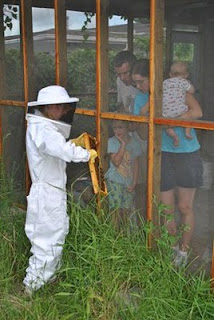
If I were keeping track of educational experiences over the summer, this would certainly count - but of course, kids don't just learn during formal school time.

Look who lost a tooth! We took bets on when it would come out. I lost badly - I said it would hang in there until after Paul left. Ari came closest - he guessed it would be on the way to pick Paul up from the airport, whereas it actually happened the night before he arrived.

We went to the zoo, and E enjoyed the Komodo dragon. We reconnected with one of my oldest friends, whose family always invited us over for Thanksgiving when we lived in Dallas. We had so much fun with Joy, we completely forgot to photograph her!
We headed to Galveston on the Sunday afternoon after Paul arrived, and had great fun splashing in the surf along with Ari's brother Dar and his little boy (Michelle was busy that afternoon).


When wading, what do you do if you see this?


The stingray came close to me (I jumped, it fluttered away), closer to Paul, and actually swam right over Dar's foot (Dar had the sense to hold completely still as the tail brushed by his ankle).
E had a blast in the waves.

B, on the other hand, thought it was much too big and splashy of a bathtub for his taste (though the temperature was about the same), and whimpered for almost an hour, continuously. Fortunately, this tired him out.

The next day, all of us (except Dar, who had to work) went to the aquarium at Moody Gardens. Paul enjoyed some quality time with his youngest nephew,

and P and E had a blast running from their uncle in front of a tankful of sharks.

That evening, Dar and Michelle opened their beehive for us. They wore their full bee suits, and Ari put on a spare hat of theirs and a sweatshirt and took pictures.

Everyone wearing bee protection got to see a bee in the process of being born (you can see her in the middle of this picture).

Michelle came over and showed the rest of us, who were protected by the screen porch, what they were doing.

If I were keeping track of educational experiences over the summer, this would certainly count - but of course, kids don't just learn during formal school time.
Subscribe to:
Posts (Atom)